


Shipping container truck: Top 3 Types for Smooth Delivery
The Journey of Your Shipping Container: Trucks That Make it Happen
A shipping container truck is a specialized vehicle built to move large shipping containers from one place to another. These trucks are essential for getting containers where they need to go, whether to a job site, a storage facility, or a new home.
Here’s a quick overview of how a shipping container gets delivered:
- Site Preparation: Ensure your delivery area is firm, level, and clear of any obstacles.
- Truck Arrival: A specialized truck, often a tilt-bed, arrives at your location with the container.
- Unloading: The truck uses its hydraulic system to gently slide the container onto the prepared ground.
- Final Placement: The container is positioned exactly where you need it, ready for use.
Getting a shipping container to its final spot involves more than just driving. It requires the right truck, careful planning, and understanding how these big boxes interact with their transport.
I’m Steve Hyndman, Vice President of Aztec Container. With three decades in the business, I’ve gained extensive experience with the logistics and operation of shipping container trucks, ensuring our customers receive quality products with excellent service. Now, let’s explore the incredible vehicles that make these deliveries possible.

Shipping container truck terms simplified:
The Workhorses: Types of Shipping Container Trucks
Ever wonder how those big, sturdy shipping containers get from point A to point B? It’s not just any old truck that can do the job! Here at Aztec Container, we rely on a fantastic fleet of specialized shipping container trucks, each one a workhorse designed for a particular kind of mission. Think of them as different tools for different jobs – some are perfect for quick, local drops, while others are built for the long haul. Knowing which truck is right for your delivery helps us get your container exactly where it needs to be, safely and smoothly.
| Feature | Tilt Bed Truck (Roll-Back) | Flatbed Truck | Chassis Trailer |
|---|---|---|---|
| Unloading Method | Hydraulic tilt, slides container off onto the ground | Requires external crane or forklift for loading/unloading | Requires external crane or forklift for loading/unloading |
| Required On-site Equipment | None | Crane or specialty forklift (6-8 ft tines, 15,000+ lbs capacity) | Crane or specialty forklift (6-8 ft tines, 15,000+ lbs capacity) |
| Best For (Distance/Container Size) | Short distances (<200 miles), 20-foot and some 40-foot containers | Long distances (>200 miles), 40-foot and high-cube containers | Intermodal transport, port/rail drayage, loaded containers |
| Typical Use Case | Ground-level delivery to residential or commercial sites | Bulk purchases, remote locations, large project sites, long-haul | Transporting loaded containers from ports/rail, long-term storage on chassis |
Tilt Bed Trucks (Roll-Back Trucks)
First up, meet the tilt bed truck, often lovingly called a “roll-back” truck. If you’re getting a container delivered right onto the ground at your home or business, chances are this is the hero of the day! It’s our most popular choice, especially for those handy 20-foot shipping containers. Why? Because it’s a master of self-unloading.
Picture this: The truck arrives, and its entire bed gently tilts backward, then slides, letting the container gracefully roll off and settle onto your prepared spot. It’s like magic! No need for you to scramble for a crane or a forklift – the truck does all the heavy lifting (or, in this case, the gentle lowering) itself thanks to its clever hydraulic system.
These shipping container trucks are perfect for deliveries within about 200 miles, making them super efficient for local drop-offs where you need precise placement. While they shine with 20-footers, some bigger tilt beds can even manage 40-foot containers if your site has plenty of wiggle room.
Flatbed & Step-Deck Trucks
Now, what if your container is going on a bit of a road trip? For longer journeys, usually more than 200 miles, the flatbed truck steps in as the most economical option. Unlike our self-unloading tilt beds, flatbeds are more like a simple, long, flat stage on wheels. This means you’ll need to have a crane or a powerful forklift ready on your end to carefully lift the container off the truck when it arrives.
Flatbed trailers are incredibly versatile and often pulled by a semi-truck. They’re fantastic for hauling those larger 40-foot shipping containers, whether they’re empty or packed to the brim. A close cousin is the step-deck truck, which has a lower section in its deck. This design is a real lifesaver for taller items, like our high-cube containers (which are 9.5 feet tall, compared to the standard 8.5 feet). That lower profile helps them glide under bridges and other overhead obstacles without a hitch!
Safety is always our top priority. Hauling these massive containers on flatbeds requires a keen eye for detail. Our drivers are pros at ensuring the weight is perfectly distributed and that the container is secured with super-strong straps and chains. We take great care to follow all safety protocols, because a smooth, safe delivery is a happy delivery. You can learn more about these important guidelines and essential safety tips for flatbed hauling.
Chassis Trailers
Finally, let’s talk about the chassis trailer. Think of this as the container’s dedicated skateboard! It’s a specialized, bare-bones trailer built just to cradle a shipping container. You’ll see these workhorses a lot around ports and rail yards, moving containers on and off trains and ships – a process often called “drayage.”
The container actually locks right onto the chassis using clever devices called “twist locks” at each corner. These locks ensure the container is super secure and won’t budge an inch during its journey, even with heavy loads. Chassis trailers are often used for transporting loaded containers, so they’re designed to handle serious weight. Just like flatbeds, they do not self-unload. So, if your container arrives on a chassis, you’ll need a trusty crane or a beefy forklift ready to lift it off. One thing to keep in mind: if you can’t unload the container right away, sometimes there can be a small daily rental fee for keeping the container on the chassis. This setup is perfect if you need the container to stay mobile on the chassis for a while, perhaps as a temporary storage solution at your facility.
Preparing Your Site for a Smooth Delivery
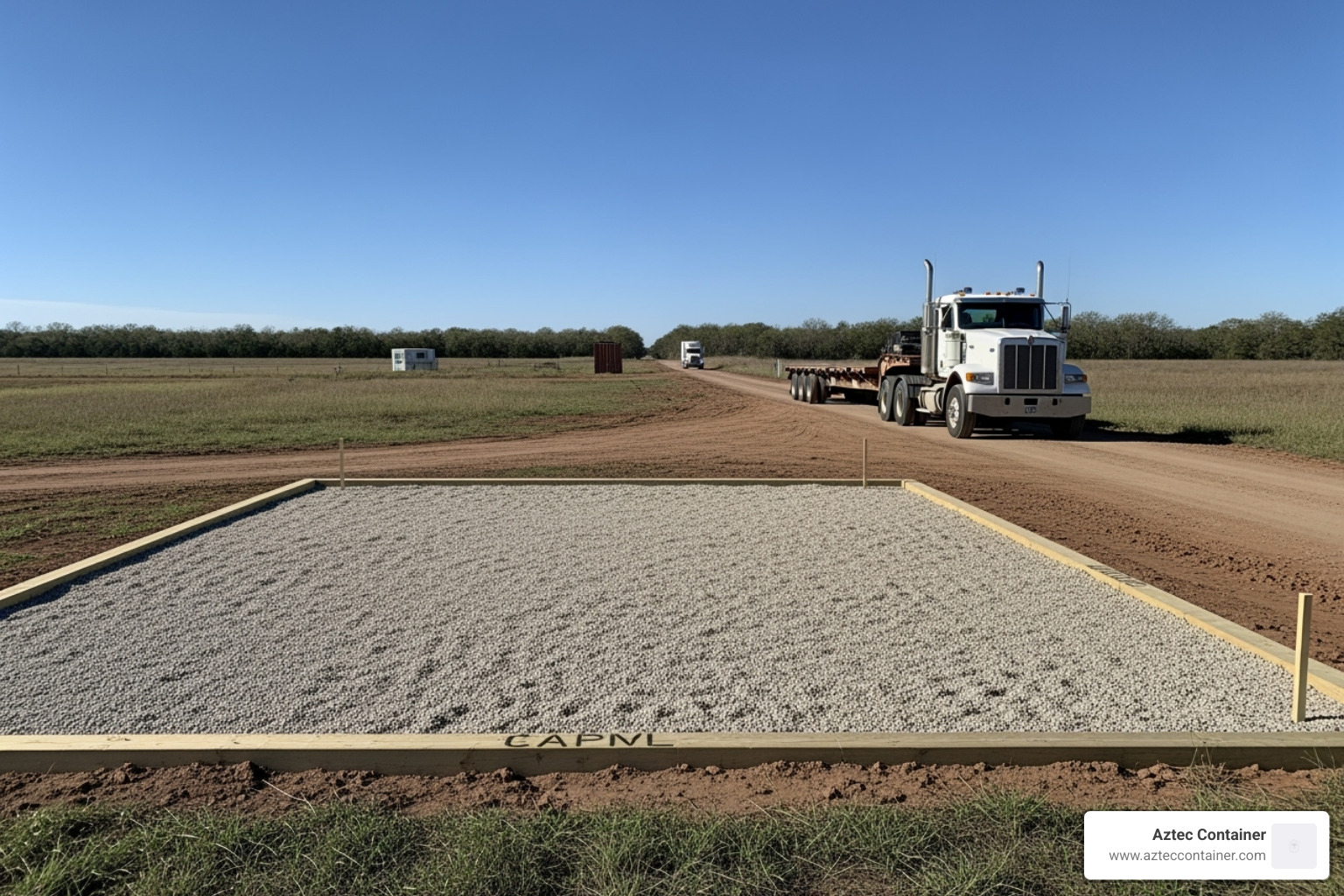
The success of your container delivery hinges significantly on site preparation. Think of it as preparing a cozy spot for your new, very large, metal friend. A little planning goes a long way in ensuring a safe, efficient, and cost-effective delivery. Our drivers are experts at what they do, but even the best driver needs a well-prepared site to work their magic.
Critical Clearance and Space Requirements
Shipping container trucks are big, heavy, and need a lot of room to maneuver. We’re not talking about parallel parking a sedan!
- Road Width: The access roads leading to your property and the delivery path itself need to be at least 13 to 15 feet wide. Our trucks are typically 10 feet wide, and we need an additional foot of space on each side for safe maneuvering, totaling a minimum of 12 feet wide.
- Vertical Clearance: When a container is on a truck, its height is approximately 12.5 feet. However, if we’re using a tilt bed truck, the nose of the container can reach between 15 to 18 feet in the air as it tilts. This means we need clear overhead space of at least 16 to 18 feet, free from low-hanging power lines, tree branches, or other obstructions. We’ve seen some unfortunate incidents where a low branch or wire caused delays, so checking this beforehand is crucial!
- Straight-Line Clearance: This is perhaps the most critical measurement. Once our truck enters your property, it needs a long, straight path to position the container accurately.
- For a 20-foot container, the truck will require a minimum of 65 feet of straight-line clearance.
- For a 40-foot container, the truck will require a minimum of 110 feet of straight-line clearance.
This space accounts for the length of the truck, the trailer, and the container itself as it slides off.
- Turning Radius: Beyond straight lines, our trucks need ample space to turn. Imagine a large school bus trying to steer your driveway – it’s similar, but often bigger. Ensure there’s enough room for the truck to make wide turns from the roadway onto your property and to position itself for the final drop-off. Any tight corners, fences, or parked vehicles can become major obstacles.
Ground Conditions and Foundation
The ground beneath your container is just as important as the space around it. Our shipping container trucks are incredibly heavy; a container can weigh up to 9,000 lbs, and combined with the truck, the total weight can easily exceed 45,000 lbs (over 20,000 kg). This kind of weight on soft ground is a recipe for disaster.
- Firm and Dry Ground: The ground must be dry and firm, ideally asphalt, concrete, or well-compacted gravel. Our trucks simply cannot drive over soft ground, mud, or wet grass. Attempting to do so risks the truck getting stuck, which can lead to significant delays and the need for a very large, very expensive tow truck. We’ve had situations where drivers, for safety reasons, have had to refuse delivery if the ground conditions are unsafe.
- Level Surface: For the container to sit correctly and for its doors to function properly, the ground needs to be as level as possible. While our drivers are skilled, they can’t defy gravity!
- Foundation Materials: To ensure the longevity of your container and prevent moisture issues, we recommend placing it on a proper foundation. Direct contact with grass or surfaces where water can pool can lead to undercarriage rot over time. Best practices include:
- A concrete pad
- Pavement
- A crushed gravel bed
- Railroad ties
- Wood blocks
These materials lift the container slightly, allowing for drainage and air circulation, extending its lifespan.
By taking these site preparation steps, you’re not just making our job easier; you’re ensuring your container delivery is smooth, safe, and sets your container up for a long, happy life on your property.
The Delivery Process: What to Expect on the Day
The day your shipping container arrives is an exciting one! To ensure everything goes off without a hitch, it helps to understand the nuances of the delivery process. From the moment our driver calls you to the final placement of your container, every detail matters.

How Container Size and Weight Impact Delivery
The size and weight of your shipping container significantly influence the type of shipping container truck we use and how we deliver it. It’s like choosing the right tool for the job!
For a 20-foot container, our trusty tilt-bed trucks are usually the perfect fit. They can handle these containers with ease, sliding them gently onto your prepared site. However, when we’re talking about a 40-foot container, especially a tall high-cube, we often need a flatbed or a larger roll-back truck. A 40-foot container needs a lot more room to maneuver – about 110 feet of straight-line clearance compared to 65 feet for a 20-footer.
The biggest difference in delivery often comes down to whether your container is empty or loaded. An empty container is a lightweight champion, usually around 5,000 lbs. While still substantial, it’s much easier for our trucks to handle for a ground-level drop-off.
But a loaded container? That’s a whole different ballgame! The weight can change dramatically. A 20-foot loaded container might be up to 8,000 lbs, while a 40-foot standard can reach 15,000 lbs, and a high-cube even more, up to 17,000 lbs. If your container is loaded, it might be too heavy for a simple tilt-bed delivery and could require a crane to move it. It’s super important to let us know if your container will be loaded and its approximate weight.
All shipping containers are built to strict global standards set by ISO. These standardized dimensions are what allow them to fit perfectly on our specialized trucks and chassis, ensuring smooth transport. You can learn more about these dimensions directly from Standard container dimensions from ISO.
The Role of Cranes and Forklifts
While our tilt-bed trucks are amazing at self-unloading, sometimes you’ll need a little extra muscle on site. This is especially true if your container arrives on a flatbed or chassis trailer.
If your container arrives on a flatbed, you’ll need either a crane or a powerful, heavy-duty forklift to lift it off. Think of it this way: your everyday warehouse forklift probably won’t cut it. For a 20-foot container, you’ll need a forklift with at least 6-foot tines. But for anything longer, like a 40-foot container, you’ll need a specialty forklift with 8-foot tines, capable of lifting at least 15,000 pounds.
Sometimes, a crane is the best option, especially for 40-foot containers, heavier loads, or tricky placements. Cranes offer incredible lifting power and precision. Many of our customers find renting a crane for a few hours to be a very cost-effective way to get their larger containers safely placed. At Aztec Container, we can often help you coordinate the rental of this equipment, or at least point you in the right direction to source it locally.
Potential Challenges and Additional Costs
We always aim for a super smooth delivery, but sometimes unexpected things happen. Being prepared and communicating openly with our team can help avoid these potential challenges and extra costs.
First off, site access issues are probably the most common hurdle. If there isn’t enough clearance (width, height, or straight-line) or if the turning radius is too tight, our shipping container truck might not be able to safely reach your desired spot. If our driver can’t safely maneuver, they might have to refuse delivery, and that can result in what we call a “dry run” fee. It’s like ordering pizza, and the delivery driver can’t get to your door!
Then there’s the issue of soft ground. Our trucks are incredibly heavy, and they simply cannot drive on soft, muddy, or wet ground. If a truck gets stuck, it’s a big problem. It requires specialized towing, which is very expensive, and that cost would be added to your bill. We really encourage you to check your ground conditions, especially after rain, and let us know if you have any concerns.
Weather delays can also pop up. Heavy rain, snow, or strong winds can make delivery unsafe or even impossible. While we do our best to stick to schedules, safety is always our top priority. We’ll definitely communicate any weather-related delays and work with you to reschedule.
Finally, our drivers operate on tight schedules, so waiting time charges can apply. A typical ground-level delivery usually takes about 20 minutes once everything is ready. However, if there are delays due to inadequate site preparation, incorrect instructions, or other issues on your end, those extra minutes can add up to additional waiting time charges.
Transporting a loaded container is much more complex due to the weight. If you’re planning to move a container that’s already full, you must inform us of its approximate weight and what’s inside. For instance, hazardous materials require special permits and handling. Moving an empty container is generally much simpler and less prone to these specific challenges.
Understanding these potential pitfalls and communicating openly with our team at Aztec Container helps us ensure your delivery is as smooth and stress-free as possible.
Frequently Asked Questions about Container Transport
We get a lot of questions about how these colossal steel boxes make their way to our customers. Here, we’ll answer some of the most common inquiries about shipping container truck logistics and the broader transportation landscape.
How are shipping containers secured to trucks?
Ever wondered how those giant steel boxes stay put on the back of a truck? It’s a really smart design! Think of it like this: every shipping container has eight super strong steel corners, called corner castings. Our specialized shipping container trucks come with trailers that have special “twist locks” right where those corners sit.
When a container is gently placed onto the truck’s trailer, these twist locks fit perfectly into the corner castings. Then, our drivers simply give them a twist (some are even automatic!). This locks the container down tight, making it a solid part of the trailer. No wiggling, no sliding, even on bumpy roads or if we have to stop quickly! This clever trick, along with making sure the weight inside is balanced, keeps your container safe and sound during its journey.
How does truck transport compare to rail or boat?
It’s a great question, and the simple answer is: they all work together! Think of it like a team effort to get your container where it needs to go. This teamwork is what we call intermodal transport.
Trucks are truly the champions of last-mile delivery. While trains and boats can move containers across vast distances, only a shipping container truck can pull right up to your home, business, or job site. They give us amazing flexibility, especially for local and regional deliveries, ensuring your container lands exactly where you need it, even in trickier spots. They’re the final, crucial link in the chain!
Now, trains are fantastic for really long trips across the country, moving huge numbers of containers between big cities or hubs. For example, trains are super efficient for long-distance hauling over continents. But, a train can’t drop off a container in your backyard, can it? That’s where trucks step in! Containers hop off the train at a rail yard and onto a shipping container truck for that final stretch.
And for moving things across oceans, nothing beats a big boat. These massive container ships carry mountains of goods around the world. Once they dock at a port, those containers are unloaded and then, you guessed it, they often get picked up by a truck or a train for their journey inland.
So, while boats and trains handle the long hauls, it’s our shipping container trucks that provide that essential direct access and flexibility, making sure your container arrives right at your doorstep.
What safety regulations are involved in shipping container trucking?
When it comes to moving these big, heavy containers, safety is always our top priority. Our shipping container trucks follow a lot of rules, both federal and state, all designed to keep everyone – our drivers, your container, and folks on the road – safe.
First off, cargo securement is huge. Remember those twist locks we talked about? Rules make sure they’re used just right and checked often. Sadly, a lot of truck accidents (about 13% of them in the U.S.) happen because cargo isn’t secured properly, which can lead to serious problems. So, we make sure everything is cinched down tight!
Then there are vehicle weight limits. Trucks can only carry so much! We have strict rules about the total weight of the truck and container, and how much weight can be on each axle. An overloaded truck is just plain dangerous, so our drivers are pros at making sure your container’s weight is balanced and legal.
To fight driver fatigue, there are also driver hours-of-service (HOS) rules. These limit how long a driver can be on the road. Our drivers stick to these rules strictly, ensuring they’re always rested and sharp behind the wheel.
And, just like any vehicle, our trucks get regular check-ups. Vehicle maintenance and inspection are mandatory. Our drivers do a thorough check before and after every trip, looking at everything from brakes to tires to lights. It’s all about keeping our fleet in tip-top shape.
Sometimes, for containers that are extra large or really heavy, we need special permits. These come from state authorities and might even mean specific routes or times we can travel, or even needing escort vehicles. It’s all part of making sure unusual loads are handled safely.
Beyond all the rules, our drivers get tons of training and awareness. They’re skilled at defensive driving, checking out delivery sites, and safely loading and unloading containers. They’re truly our eyes and ears on the ground, making smart calls to ensure a safe delivery every time.
We take all these rules and best practices incredibly seriously. It’s how we stay committed to safety and provide reliable service across all the areas we operate, including Arizona, California, Colorado, Idaho, Montana, Nevada, New Mexico, Texas, and Utah.
Conclusion
Phew, what a journey we’ve taken! From the mighty tilt-bed to the long-distance flatbed and the specialized chassis, we’ve explored the incredible shipping container trucks that make moving these big steel boxes possible. It’s truly a dance of sophisticated logistics, all designed to get your container right to your doorstep.
We’ve learned that success isn’t just about the truck; it’s a team effort! Your part, the crucial site preparation, ensures everything goes smoothly. Remembering those critical clearance measurements and making sure your ground is firm and level can save a lot of headaches (and extra costs!). We’ve also highlighted how your container’s size and weight influence the delivery, and when extra helpers like cranes or forklifts might be needed.
While we always aim for perfection, sometimes Mother Nature or unexpected site quirks can pop up. The best defense against these challenges? Clear and open communication with our team! We’re here to help steer any bumps in the road.
At Aztec Container, we’ve been mastering this complex process for decades. Our expertise means that whether you’re in sunny California, the vast lands of Texas, or any of the other states we serve like Arizona, Colorado, Idaho, Montana, Nevada, New Mexico, or Utah, your container delivery will be handled safely and efficiently.
Understanding the logistics of a shipping container truck is really the first step toward a successful delivery. Site preparation is crucial, and a quick chat with your provider can make all the difference for a smooth experience.
Ready to get started? Learn more about our delivery process and get a quote by visiting our website!