


What Exactly Is a 40-Foot Shipping Container?
A 40-foot shipping container is a steel intermodal unit built to ISO 668 dimensional standards, meaning its corner castings, footprint, and stacking geometry are identical across manufacturers worldwide. That standardization is the reason a container purchased in one state can be handled by equipment in another without modification.
The shell is fabricated from Corten-type weathering steel with corrugated side panels. The corrugation is structural: it stiffens thin-gauge panels so the unit can carry stacked loads through its corner posts rather than its walls. The floor is typically 1 1/8″ marine-grade plywood laid over steel cross-members.
Buyers commonly search for these units as “conex boxes,” “sea containers,” or “cargo containers.” The terms describe the same ISO-standard asset.
40-Foot Container Dimensions and Capacity
The table below reflects standard ISO 40-foot specifications as listed by Aztec Container.
| Measurement | Standard 40′ | 40′ High Cube |
| Exterior length | 40′ | 40′ |
| Exterior width | 8′ | 8′ |
| Exterior height | 8′ 6″ | 9′ 6″ |
| Interior width | 7′ 8.5″ | 7′ 8.5″ |
| Interior height | 7′ 10 3/16″ | ≈ 8′ 10″ |
How Do Condition Grades Change What You Pay?
Condition is the single largest price variable in the 40-foot market. Grades are described consistently across the industry.
| Grade | What It Means | Typical Buyer |
| New / One-Trip | Manufactured recently, used for a single cargo movement. Minimal surface marks, factory paint, original door hardware. | Buyers converting units to offices, retail, or customer-facing structures |
| Cargo-Worthy (CW) | Certified as structurally sound for international shipping. Surface oxidation and cosmetic dents are expected. | Buyers who need certification for transport or export |
| Used / Storage Grade | Retired from shipping service. Sound structure, visible cosmetic wear, patch repairs possible. | On-site storage, job sites, agricultural and equipment storage |
| As-Is | Sold with known defects disclosed. Lowest price point. | Buyers doing heavy modification or salvage |
Which Door Configuration Fits Your Use Case?
Door layout determines how you actually work inside the container, and it is the most under-considered decision in the buying process. Aztec Container stocks 40-foot units across the following configurations.
| Configuration | Access Pattern | Best Suited To |
| Standard cargo doors | Double swing doors at one end | General storage, palletized goods loaded by forklift from one end |
| 1 roll-up door | Single roll-up on the side or end | Frequent access where swing-door clearance is limited |
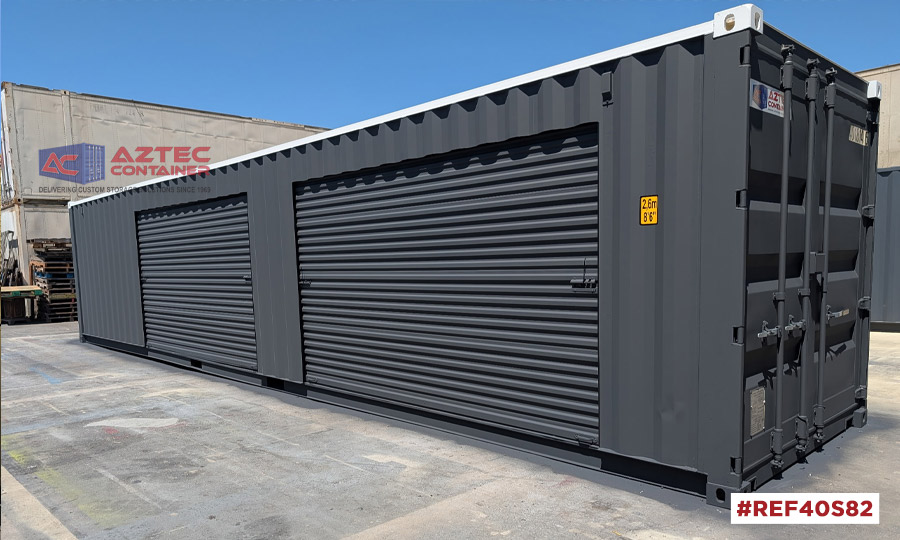
| 2–4 roll-up doors | Multiple side access points along the 40′ run | Tool cribs, multi-crew job sites, rental yards, partitioned storage |
| Full side open | Entire 40′ side opens | Loading long or oversized items; equipment that cannot be maneuvered end-to-end |
| Office container | Windows, personnel door, electrical, insulation package | Site offices, security posts, administrative space |
| Insulated | Lined interior with insulation package | Temperature-sensitive inventory requiring a controlled interior |
| Refrigerated | Integrated refrigeration unit | Cold-chain storage and perishable inventory |
| Car storage | Modified for vehicle entry | Classic and project vehicle storage |
What Drives the Price of a 40-Foot Container?
Four inputs account for most of the variance between quotes:
- Condition grade — one-trip units carry a significant premium over storage-grade equivalents.
- Door and modification package — each additional roll-up door, window, vent, or partition adds fabrication labor.
- Standard vs. high cube — high cubes usually price above standard height and are scarcer in some regional markets.
- Regional inventory depth — availability at the nearest depot influences pricing more than most buyers expect, which is why quotes vary state to state.
Because these four inputs interact, published “average prices” are unreliable as a budgeting tool. A specification-based quote against your actual configuration is the only accurate figure.
Site and Permitting Considerations
Two items belong on every pre-purchase checklist.
Ground preparation. A loaded 40-foot container concentrates weight through four corner castings. Level, compacted ground is the baseline requirement; many buyers set units on railroad ties, concrete blocks, or a poured pad at the corners to keep the frame square and the doors aligned. A container that sits on uneven ground will show it first in doors that bind.
Permitting. Requirements vary by city, county, and zoning district. Some jurisdictions treat a container as temporary equipment with no permit required, while others classify it as an accessory structure subject to setback rules, screening requirements, or a permit application. This is general guidance only — confirm with your local building or planning department before purchase.
About Aztec Container
Aztec Container has supplied ISO steel shipping containers since 1969, operating from 2600 S Santa Fe Ave, Vista, CA 92084. The company is a member of the National Portable Storage Association (NPSA) and offers container sales nationwide, with rental availability in California. Inventory spans 10-foot, 20-foot, and 40-foot units across storage, office, insulated, refrigerated, and custom configurations.
For a specification-based quote on a 40-foot container, call 1-800-399-2126 or submit a request through the quote form.
Frequently Asked Questions
How much does a 40-foot shipping container cost?
There’s no single number, and any site quoting one is guessing. Price moves with condition grade, how many doors you want cut in, whether you need standard or high cube, and what’s sitting in the nearest depot. A one-trip unit with roll-up doors and a used storage-grade unit with standard cargo doors can be thousands apart. Call 1-800-399-2126 with your specs and you’ll get a real figure instead of a range.
How many square feet is a 40-foot container?
The exterior footprint is 320 square feet (40 × 8). Usable interior floor space comes to about 304 square feet once you account for wall thickness. If you’re planning a layout, use 304 — that’s the number that matters when you’re fitting racking or pallets.
What’s the difference between a standard 40-foot and a high cube?
One foot of height. A standard is 8′ 6″ tall outside; a high cube is 9′ 6″. Same length, same width, same ground footprint. Inside, that translates to roughly 8′ 10″ of headroom instead of 7′ 10″ — about 12% more volume. If you’re double-stacking pallets or building out a workspace, the high cube is usually worth it. For flat storage, the standard is fine.
Should I buy one 40-foot or two 20-foot containers?
Ask yourself whether you’ll ever want the units in two different places. If yes, buy two 20s. If everything stays on one site and you’re storing anything long — lumber, pipe, conduit, ladders — buy the 40. You’ll also usually pay less per square foot with the 40.
What does “cargo-worthy” actually mean?
It means the unit has been inspected and certified as structurally sound enough for international shipping. It does not mean it looks new. Expect surface oxidation, dents, and repaired patches. If you want a container that looks clean, you’re looking for one-trip, not cargo-worthy.
Can I put windows, doors, or electrical in a 40-foot container?
Yes. Container modification is routine work — personnel doors, windows, roll-up doors, vents, partitions, insulation, and electrical packages are all standard requests. The cleanest approach is to specify your modifications at the time of purchase rather than retrofitting later, since the fabrication happens before the unit ships.
What kind of ground does a 40-foot container need?
Level and firm. The container carries its weight through four corner castings, so those four points need to sit at the same height. Gravel, compacted dirt, asphalt, and concrete all work. Most buyers set the corners on railroad ties or concrete blocks. Skip this step and the first symptom is doors that won’t latch cleanly.
Do I need a permit to put a container on my property?
It depends entirely on where you are. Some jurisdictions don’t regulate them at all, others treat them as accessory structures with setback and screening rules, and a few require a permit application before placement. This is general guidance — call your city or county planning department and ask specifically about shipping containers on your parcel type.
How much weight can a 40-foot container hold?
A standard 40-foot unit has a maximum gross weight around 67,200 lbs. Subtract the tare weight of roughly 8,200 lbs and you have a payload capacity near 59,000 lbs. For nearly all storage applications you’ll run out of floor space long before you approach that limit.
What are 40-foot containers actually used for besides shipping?
The common ones: contractor and job-site storage, equipment and tool storage, agricultural and ranch storage, retail overstock, classic car storage, on-site offices, guard shacks, concession stands, and refrigerated or insulated storage for temperature-sensitive inventory. Aztec Container stocks purpose-built configurations for most of these rather than requiring a full custom build.