


40 foot container transport: 7 Powerful Tips for Easy Success 2025
Understanding 40 Foot Container Transport: The Basics
40 foot container transport is the process of moving standard ISO shipping containers by truck, rail, ship, or a combination of these methods. Here’s what you need to know:
| Transport Method | Best For | Typical Equipment Needed |
|---|---|---|
| Road/Truck | Local delivery, port to destination | Chassis trailer, flatbed, or tilt-bed |
| Rail | Long-distance inland transport | Intermodal railcars |
| Ocean | International shipping | Container vessels |
| Intermodal | Combined transport methods | Various (chassis, cranes, etc.) |
The global shipping industry relies heavily on 40-foot containers, with over 90% of the world’s cargo moving in standardized containers. These rectangular steel boxes revolutionized global trade by creating a universal shipping module that can be easily transferred between trucks, trains and ships without unloading the contents.
Key specifications:
* Internal dimensions: 39’6″ × 7’8″ × 7’10”
* External dimensions: 40′ × 8′ × 8’6″
* Empty weight: 8,000-8,500 lbs
* Maximum payload: 58,000-59,000 lbs
* Capacity: 2,390 cubic feet (fits approximately 20 standard pallets)
When planning for 40 foot container transport, you’ll need to consider site accessibility, loading/unloading equipment, permits for oversized loads, and proper weight distribution. The process typically involves scheduling pickup, arranging appropriate transport equipment, securing necessary permits, and coordinating delivery to the final destination.
I’m Steve Hyndman, Vice President of Aztec Container with over 25 years of experience coordinating 40 foot container transport nationwide for businesses ranging from construction companies to retail operations. My expertise includes managing logistics for both standard and customized container deliveries across various terrains and regulatory environments.

40 foot container transport terms explained:
– 40 foot container delivery
– shipping 40 ft container
– how much does a 40 foot conex box weigh
Why 40-Foot Containers Dominate Global Freight
The 40-foot container has become the backbone of global shipping since its standardization in the 1960s. Before the adoption of the International Organization for Standardization (ISO) standards, shipping was a chaotic and labor-intensive process. Goods were individually loaded and unloaded at each transfer point, resulting in damage, theft, and significant delays.
The adoption of the ISO standard transformed global trade by creating uniformity in shipping containers. Today, these steel boxes account for over 90% of all cargo moved worldwide, making the 40 foot container transport industry one of the most critical components of the global supply chain.
At Aztec Container, we’ve witnessed this evolution firsthand, adapting our services to meet the growing demand for efficient container transport solutions across our service areas in Arizona, California, Colorado, Idaho, Montana, Nevada, New Mexico, Texas, and Utah.
40-Foot Container Dimensions & Capacities
Let’s talk about what you’re actually getting when you invest in a 40-foot container. Understanding these dimensions isn’t just about numbers on paper – it’s about knowing exactly what you can fit inside and how to plan your transport effectively.
A standard 40-foot shipping container gives you about 2,390 cubic feet of usable space. That’s room enough to ship everything from a household move to commercial inventory or even heavy machinery. When I talk with customers, I often explain it as “about the size of a two-car garage” – that helps people visualize the space better.
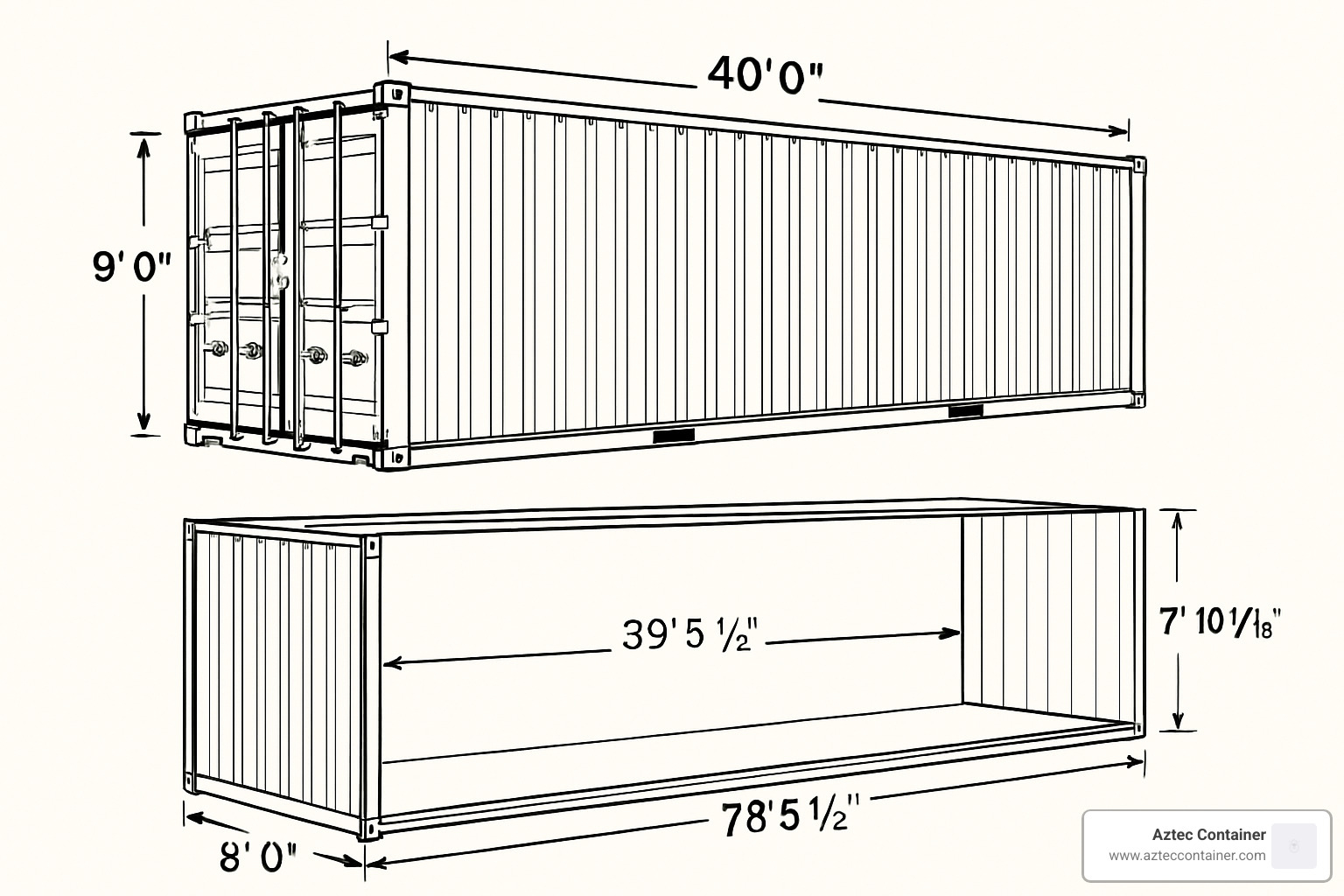
| Container Type | External Dimensions | Internal Dimensions | Door Opening | Tare Weight | Max Payload |
|---|---|---|---|---|---|
| Standard 40′ | 40′ × 8′ × 8’6″ | 39’6″ × 7’8″ × 7’10” | 7’8″ × 7’6″ | 8,000-8,500 lbs | 58,000-59,000 lbs |
| High Cube 40′ | 40′ × 8′ × 9’6″ | 39’6″ × 7’8″ × 8’10” | 7’8″ × 8’6″ | 8,750-9,200 lbs | 58,000-58,500 lbs |
| Flat Rack 40′ | 40′ × 8′ × 8’6″ | 39’6″ × 7’8″ × 7’10” | Open sides | 12,000-12,500 lbs | 85,800 lbs |
One of the biggest advantages of a 40-footer is that it fits approximately 20 standard pallets (48″ × 40″). This is a game-changer for businesses looking to consolidate shipments and bring down their per-unit shipping costs. I’ve had customers cut their logistics expenses significantly just by optimizing how they use this space.
Interior & Exterior Measurements
Inside a standard 40-foot container, you’ve got exactly 39 feet 6 inches of length, 7 feet 8 inches of width, and 7 feet 10 inches of height. That gives you those 2,390 cubic feet I mentioned earlier – plenty of room for most shipping needs.
The outside dimensions – 40 feet long, 8 feet wide, and 8 feet 6 inches high – matter just as much. These measurements determine what equipment you’ll need for transport and whether you’ll face any restrictions on roads, bridges, or at terminals.
Got taller items to ship? I often recommend our high cube option to customers. It gives you an extra foot of interior height (8’10” instead of 7’10”), which can make all the difference when you’re trying to maximize volume or accommodate taller equipment.
Don’t forget about the door opening – it’s 7’8″ wide by 7’6″ high on a standard 40-footer. I always remind folks that no matter how big the container is inside, everything still has to fit through that opening during loading and unloading!
Payload Limits & Weight Distribution
When it comes to 40 foot container transport, weight limits are just as important as dimensions. A standard 40-foot container has a maximum gross weight of about 67,200 lbs. That includes both the container itself (8,000-8,500 lbs) and your cargo (maximum payload around 58,000-59,000 lbs).
Here’s the catch though – road restrictions in the US often limit what you can actually transport. The total weight (truck, chassis, container, and cargo) generally can’t exceed 80,000 lbs without special permits. After accounting for the truck and chassis (typically 32,000-36,000 lbs), your practical payload limit usually ends up being around 44,000-48,000 lbs for road transport.
How you distribute weight inside matters tremendously. I always tell customers to think of it like packing a pickup truck – you wouldn’t put all the heavy stuff on one side, right? The same principle applies here, but it’s even more critical. Heavy items should go toward the center rather than at either end, and weight should be evenly distributed across the floor to avoid exceeding axle weight limits.
Those corner posts on a 40-footer are engineering marvels – they can support stacking loads up to 153,000 lbs when weight is evenly distributed across all four corners. That’s why containers can be stacked up to nine high on ships! According to research from Foreign Trade Online, this remarkable stacking strength is achieved through precise engineering of the corner posts and frame structure.
At Aztec Container, we’re always happy to provide guidance on proper loading techniques. We’ve seen it all, and we can help you avoid those costly delays that happen when containers need to be reloaded due to weight distribution issues.
40 Foot Container Transport Options Explained
When it comes to moving a 40-foot container, you’ve got several ways to get the job done. What makes container shipping so brilliant is how seamlessly these big steel boxes move between trucks, trains, and ships without ever having to unpack what’s inside. It’s like a giant game of pass-the-parcel, except the wrapping stays intact!

Local 40 Foot Container Transport by Road
For shorter distances across our Western and Southwestern service areas, trucks are your go-to option. There’s nothing quite as flexible as 40 foot container transport by road when you need that container delivered right to your doorstep (well, maybe not literally—these things are huge!).
Local road transport typically costs between $2.80 and $3.10 per mile in California and nearby regions. Empty containers moving less than 200 miles usually fall between $600 and $1,200, depending on exactly how far they’re going and how tricky the delivery spot is to access.
What affects your local transport costs? Think about access restrictions like narrow city streets or low bridges that might force detours. The delivery site itself matters too—you’ll need about 120 feet of clearance for the truck to maneuver and solid ground that won’t turn to mush under all that weight. Need a crane or forklift to place the container just right? That’ll add to your bill. And don’t forget about traffic—especially around busy ports where congestion can turn a quick delivery into an all-day affair.
At Aztec Container, we work with experienced local carriers who know all the quirks of delivering these massive containers, whether you’re in a downtown area, quiet suburb, or remote rural location.
Long-Haul & Interstate Moves
When your container needs to cross state lines, things get a bit more complex. Long-distance 40 foot container transport requires careful planning to steer the patchwork of state regulations while keeping costs reasonable.
For interstate moves, keep these important factors in mind: You might need special permits if your container exceeds standard width limits (typically anything over 102 inches or 8.5 feet). Your truck will stop at weigh stations along the way to verify it’s not overloaded. Fuel surcharges will likely be part of your quote, rising and falling with diesel prices. Professional carriers develop detailed route plans to avoid low bridges and weight-restricted roads. And remember that federal regulations limit how long drivers can be behind the wheel, affecting your delivery timeline.
To give you a real-world example, sending a 40-foot container from Los Angeles to Texas typically takes 3-5 days and costs between $4,500 and $6,000, depending on the exact destination and current fuel prices.
Overseas Shipping & Intermodal Rail Links
For international shipments or cross-country hauls, combining different transport methods often makes the most sense for your wallet. This mix-and-match approach uses each transport type where it shines brightest:
Ocean transport is your budget-friendly champion for international shipping. The 40-foot container is the global standard on container ships, with Pacific crossings typically taking 15-18 days and Atlantic journeys running 10-14 days.
Rail transport can save you significant money on long domestic routes compared to trucking. Those impressive double-stack rail cars can carry two 40-foot containers stacked on top of each other, improving efficiency and lowering your per-container costs. Major rail lines connect ports to inland distribution centers across the country.
Drayage is the industry term for the short truck trips that connect ports or rail yards to your final destination. Think of it as the critical “last mile” that bridges the gap between major transport hubs and where your container ultimately needs to be.
Here’s an interesting container insight: While a 40-foot container gives you about twice the volume of a 20-footer, it can’t carry twice the weight. According to shipping experts at Shipping and Freight Resource, a 40-foot container has a volume-to-payload ratio of about 2.53 cubic meters per ton, compared to 1.54 cubic meters per ton for a 20-foot container. This makes 40-foot containers perfect for bulky-but-lighter cargo, while 20-footers often work better for dense, heavy items.
For businesses with regular shipping needs, we at Aztec Container can help you develop a smart transport strategy that makes the most of each shipping method while keeping your costs down and your goods moving on schedule.
Cost & Transit Time Benchmarks
Let’s talk money and time – two things every container buyer cares about! Understanding what 40 foot container transport typically costs and how long it takes can save you headaches and help you plan better. While prices bounce around based on fuel costs, seasonal demand, and market conditions, I can share some real-world benchmarks to help you budget and schedule.

Local Pricing Snapshot
For shorter moves within the same region, pricing generally follows a predictable pattern. Empty container moves under 200 miles typically fall between $600-$1,200, while loaded containers generally run between $2.80-$3.10 per mile in California and similar regions.
What might surprise you are the “extras” that can affect your bottom line. Access fees at certain ports can add approximately $600 at some terminals. Traffic conditions in busy urban areas naturally increase rates – nobody likes sitting in LA traffic, especially truckers burning diesel by the minute!
Equipment availability plays a huge role too. Need a specialized side-loader to place your container in a tight spot? That premium equipment comes with premium pricing, especially during busy seasons when everyone seems to need containers moved at once.
One cost that catches many first-time container buyers off guard is site preparation. If your delivery location has soft ground or other challenges, you might need wrecker assistance or special equipment – an avoidable expense if you plan ahead. At Aztec Container, we help you anticipate these costs upfront, so you don’t get blindsided by surprise charges.
National Rates & Typical Transit Times
Going the distance? Long-haul 40 foot container transport naturally costs more and takes longer. A coast-to-coast journey isn’t just about mileage – it’s about navigating different states, weather conditions, and trucking regulations.
For perspective, moving a container from Los Angeles to Texas (roughly 1,500 miles) typically runs $4,500-$6,000 and takes 3-5 days under normal conditions. Stretch that to Florida from California (about 2,700 miles), and you’re looking at $6,500-$8,000 with 5-7 days transit time.
We’ve handled specific routes like Riverside to Coral Springs (2,651.5 miles) and Moscow, ID to Riverside (1,106.2 miles) that give you a real-world idea of distances and approximate costs.
Seasonal demand creates significant price swings. Late summer into fall (August-October) is typically the busiest shipping season, when equipment and drivers become scarce and rates climb. Fuel prices add another variable – when diesel jumps, so do transport rates.
An insider tip: routes with limited backhaul opportunities (where trucks struggle to find return cargo) generally cost more. It’s simple economics – if a trucker has to deadhead back empty, someone pays for that empty trip.
For most domestic long-haul routes, you can roughly estimate 500-700 miles per day under normal conditions. This accounts for mandatory driver rest periods, refueling stops, and typical highway speeds.
International 40 Foot Container Transport Transit Times
If your container is crossing oceans, patience becomes a virtue. International shipping follows its own rhythms, with transit times varying dramatically by route:
Ocean crossings from Asia to the West Coast typically take 15-18 days, while going all the way to the East Coast via the Panama Canal stretches to 25-30 days. Trans-Atlantic shipments from Europe to the East Coast are quicker at 10-14 days. Heading to the Middle East? Plan for 30-35 days. Australia or New Zealand? That’s 25-30 days on the water.
The savvy container buyer always adds buffer time for port congestion – a growing issue at major ports, especially during peak seasons or labor disruptions. Customs clearance typically adds 2-5 days depending on the country and your documentation. And don’t forget about inland transport from the port to your final destination.
Some routes require transshipment – where your container transfers between vessels at intermediate ports. This can add 3-7 days to your timeline, but often saves money compared to direct service.
At Aztec Container, we’ve built relationships with reliable shipping lines and freight forwarders over years of doing business. This network helps us provide accurate transit estimates for international movements, so you can plan effectively whether your container is crossing the county or crossing the globe.
Regulations, Permits & Insurance Essentials
Let’s face it—the paperwork side of 40 foot container transport isn’t the most exciting part, but it’s absolutely crucial to get right. Think of permits and insurance as your safety net that keeps everything legal and protected when moving these massive steel boxes across our highways.

Obtaining Oversize & Overweight Permits
The good news is that standard 40-foot containers typically fit within normal width limits (8 feet), but there are definitely situations where permits become necessary.
When moving through different states, you’ll quickly find that each has its own unique set of rules. Some states might consider your container oversized if it has external attachments pushing it beyond 102 inches (8.5 feet) wide. Others focus more on the combined weight of everything—truck, chassis, container, and what’s inside—which can’t exceed 80,000 pounds on interstate highways without special permits.
Route-specific challenges add another layer of complexity. That perfect route might cross a bridge with strict weight limits or pass through tunnels with height restrictions. For these situations, you’ll need specialized permits that might only be valid for that single trip.
And here’s something many first-timers don’t realize—particularly large or heavy loads often require escort vehicles (those pilot cars you see with flashing lights). The requirements for these escorts vary dramatically from state to state, and sometimes even between different routes within the same state!
The permit application process isn’t something you want to tackle without experience. You’ll need to provide detailed information about dimensions and weight, plan your specific route carefully, prove you have proper insurance, and pay the applicable fees. At Aztec Container, we partner with carriers who handle all this paperwork as part of their service, ensuring your container moves legally and safely.
Mandatory Insurance & Claims Process
Insurance for 40 foot container transport isn’t just a box to check—it’s essential protection for your investment. The standard insurance package typically includes several key components working together to provide comprehensive coverage.
Cargo insurance (usually with a minimum $100,000 coverage) protects what’s inside your container if damage occurs during transport. General liability coverage steps in if there’s damage to third parties or property during loading, transport, or unloading. And motor truck cargo insurance specifically covers your goods while they’re on the road.
For high-value shipments—like expensive equipment or specialized inventory—you might need additional insurance riders. When evaluating your coverage needs, think beyond just the replacement value of what’s inside. Consider potential business disruption costs if your shipment is delayed and watch for specific exclusions that might be hiding in standard policies.
If the worst happens and your shipment sustains damage, having a clear understanding of the claims process is invaluable. Start by documenting any damage immediately upon delivery—take photos from multiple angles before anything is moved. Then promptly notify both the carrier and insurance provider (timing matters for valid claims).
An insurance adjuster will typically assess the damage, after which you’ll need to submit documentation for repair or replacement costs. The final step involves settlement negotiation, which goes much smoother when you’ve thoroughly documented everything from the beginning.
Here’s a pro tip from years of container transport experience: before shipping anything valuable, take detailed photographs of the container contents. This simple step can save tremendous headaches if you ever need to file a claim.
We’ve seen how proper permits and insurance create peace of mind for our customers. When you work with experienced professionals who understand the regulatory landscape, you can focus on your business while we handle the complex compliance requirements that keep your shipment legal and protected.
Loading, Unloading & Preparation Best Practices
Proper preparation, loading, and unloading procedures are essential for safe and efficient 40 foot container transport. Following best practices not only protects your cargo but also prevents delays and additional costs.
Step-by-Step Loading Checklist
Before loading begins, inspect the container thoroughly:
– Check for holes, dents, or damage to the structure
– Ensure doors open and close properly
– Verify the container is clean and dry
– Confirm the container number matches your documentation
When loading a 40-foot container:
-
Plan the load distribution: Create a loading plan that distributes weight evenly across the container floor. The maximum floor load rating for a standard 40-foot container is approximately 224 lbs per square foot.
-
Optimize pallet arrangement: A standard 40-foot container can accommodate 20 standard pallets (48″ × 40″) in a single layer. For efficiency, consider double-stacking when cargo permits.
-
Secure the cargo: Use appropriate dunnage, blocking, and bracing to prevent movement during transport. Containers may experience significant motion during ocean transport or rail switching operations.
-
Consider weight distribution: Place heavier items at the bottom and center of the container, with lighter items on top and toward the ends.
-
Leave inspection access: For international shipments, customs may need to inspect container contents. Arrange loads to allow some access without complete unloading.
-
Control moisture: In areas with significant temperature variations, consider using desiccants or moisture barriers to prevent condensation damage.
-
Secure doors properly: Once loading is complete, ensure container doors are properly closed and sealed with the appropriate locking mechanisms.
For businesses without loading dock facilities, we can arrange for containers to be delivered on chassis that match your loading equipment height or provide alternative loading solutions.
Safe Unloading & Site Placement
Preparing the delivery site properly is crucial for safe container placement:
-
Space requirements: Ensure at least 120 feet of horizontal clearance for tilt-bed deliveries, with 16 feet of height clearance and 10 feet of width.
-
Ground preparation: The surface must be firm, level, and dry. For long-term placement, consider a gravel bed, concrete pad, or at minimum, wood blocks under each corner to prevent sinking.
-
Obstacle assessment: Remove or identify low-hanging branches, power lines, or other obstacles that could interfere with delivery equipment.
-
Access planning: Confirm that delivery trucks can reach the placement site without encountering weight restrictions, low bridges, or tight turns.
For container unloading, consider these best practices:
-
Equipment selection: A 15,000 lbs capacity forklift with 8-foot forks is ideal for full container movement. For unloading contents, standard warehouse forklifts are typically sufficient.
-
Gradual unloading: When using forklifts, unload evenly from both sides toward the center to maintain balance, especially for containers on chassis.
-
Weather considerations: If possible, schedule unloading during good weather to protect cargo and prevent slip hazards.
-
Final placement: For long-term storage, containers should be placed on level ground with support under each corner. A slight tilt toward the doors can help with water drainage.
At Aztec Container, we can provide guidance on site preparation specific to your location and intended use, helping ensure a smooth delivery and placement process.
Choosing a Reliable Carrier & Avoiding Common Pitfalls
Selecting the right transport provider is perhaps the most critical decision in ensuring successful 40 foot container transport. I’ve seen how the difference between a professional carrier and an inexperienced one can transform your experience – either enjoying a smooth, on-time delivery or dealing with frustrating delays, unexpected damages, or regulatory headaches.

When evaluating potential carriers for your container move, think of it like hiring someone for an important job. You’ll want to check their credentials, experience, and reputation before trusting them with your valuable cargo.
First, verify the basics – does the carrier have a valid Motor Carrier (MC) number and Department of Transportation (DOT) number? These aren’t just formalities; they’re your assurance that the carrier meets federal standards. You can easily check these through the Federal Motor Carrier Safety Administration (FMCSA) website.
Next, dig into their safety record. The FMCSA maintains a Safety and Fitness Electronic Records (SAFER) System that shows safety ratings and crash histories. A carrier with a “Satisfactory” rating and minimal accidents gives you peace of mind that your container will be in good hands.
Insurance coverage matters tremendously. Confirm your carrier maintains adequate cargo insurance (minimum $100,000) and general liability coverage. Don’t just take their word for it – request certificates of insurance as verification. I’ve seen too many customers learn the hard way that verbal assurances don’t pay for damages.
Container-specific experience is non-negotiable. Moving a 40-foot container isn’t the same as general freight. Ask pointed questions about their experience specifically with container moves and what specialized equipment they use. A knowledgeable carrier will happily share details about their chassis types, securing methods, and delivery equipment.
Check references from past customers with similar shipping needs. Online reviews can also provide valuable insights into a carrier’s reliability. A carrier with a solid reputation has earned it through consistent performance.
Transparent pricing is a hallmark of professional carriers. They’ll provide detailed quotes that clearly itemize all potential costs. Be wary of quotes that seem too good to be true – they usually are! Unusually low estimates often hide fees that appear later or indicate inadequate equipment and insurance.
Finally, establish clear communication expectations. Will they provide regular updates? Who’s your point of contact if issues arise? Professional carriers value communication and make it easy to stay informed throughout the transport process.
At Aztec Container, we’ve built relationships with reliable carriers throughout our service regions, carefully vetting each one to ensure they meet our standards for reliability, safety, and customer service. This allows us to match each customer with the right transport provider for their specific needs.
Red Flags When Booking 40 Foot Container Transport
After years in this business, I’ve learned to spot warning signs that might indicate you’re dealing with an unreliable carrier. Consider these your early warning system:
Lack of permit knowledge is a major red flag. If a carrier seems confused about permit requirements for your route or cargo weight, that suggests inexperience with container transport. Professionals know exactly what permits are needed for specific routes and loads.
Vague or extremely low pricing often hides unpleasant surprises. Legitimate carriers have similar cost structures based on real expenses like fuel, labor, and equipment. If one quote is significantly lower than others, something’s probably missing.
No physical address or verifiable business information should make you pause. Reputable carriers maintain real locations and aren’t operating solely from a cell phone.
When discussing your move, professional carriers will clearly describe the exact equipment they’ll use and why it’s appropriate for your specific container. Vague responses like “we have trucks” instead of specifics about chassis types or lifting equipment suggest a concerning lack of expertise.
Be cautious of carriers requiring large upfront deposits. While some payment in advance is normal industry practice, excessive advance payments might indicate a problematic operator.
Poor communication during the booking process often predicts similar frustrations during the actual transport. If they’re hard to reach or provide vague answers now, imagine trying to get updates when your container is in transit!
Finally, professional carriers should be able to describe their contingency plans for common challenges. What happens if equipment breaks down? How do they handle weather delays? The best carriers have established procedures for these situations and will openly share them.
By carefully vetting carriers and watching for these warning signs, you can dramatically reduce the risk of problems with your 40 foot container transport. We’ve seen how much smoother the process goes when working with true professionals who take pride in their service and reliability.
Frequently Asked Questions about 40-Foot Container Moves
How many pallets fit in a 40-foot container?
One of the most common questions I hear from customers is about pallet capacity. A standard 40-foot container comfortably fits about 20 standard American pallets (48″ × 40″) in a single layer on the floor. If your cargo allows for safe stacking, you can potentially double this capacity and really maximize your shipping value.
European shipping? Euro pallets (47.2″ × 31.5″) work beautifully in these containers too – you can fit around 24-25 in a single layer thanks to their slightly smaller footprint.
The exact number ultimately depends on several practical factors: the specific dimensions of your pallets, whether they can be safely stacked, how much space you need for proper cargo securing (never skimp on this!), and maintaining proper weight distribution throughout the container.
I always recommend sketching out a detailed loading plan before your shipment. This small bit of preparation ensures both efficient space utilization and proper weight balance across the container floor – which keeps your goods safer and can prevent costly reloading requirements.
Do I need a crane at both ends of the trip?
Good news – you don’t necessarily need cranes at either end of your journey. This really depends on your specific situation:
If your container travels on a chassis or flatbed that stays with the container during loading/unloading, you might not need a crane at all. Many of our customers are surprised to learn about the alternatives available for 40 foot container transport.
Side-loader trucks are fantastic options – they can lift containers directly from their chassis onto the ground. Tilt-bed trailers can slide containers off smoothly, and heavy-capacity forklifts (15,000+ lbs with extended forks) work well in many scenarios.
Site conditions play a major role too. If you’re dealing with a tight space that can’t accommodate specialized equipment, cranes might be your only practical option. The container’s weight is another consideration – fully loaded containers generally require more substantial handling equipment than empty ones.
At Aztec Container, we help determine the most cost-effective loading and unloading methods based on your specific site conditions and what equipment is available in your area. Sometimes a simple solution works perfectly, saving you considerable expense.
What’s the difference between moving an empty vs loaded unit?
Moving empty containers is an entirely different ballgame from transporting loaded ones – this is something many first-time container buyers don’t realize until they’re arranging transport.
Weight is the biggest factor – an empty 40-foot container weighs around 8,000-8,500 lbs, while a fully loaded one can tip the scales at up to 67,200 lbs. This dramatic weight difference affects everything from the equipment needed to permits required.
Empty containers can often be moved with lighter-duty equipment like tilt-bed trailers. For quick repositioning of an empty container, a forklift with just 5,000 lbs capacity can lift one end for dragging. Loaded containers, however, typically require specially designed chassis and forklifts with at least 15,000 lbs capacity.
There’s also a significant cost difference. For long distances, moving empty containers often isn’t economical—sometimes it’s actually cheaper to purchase a new container at your destination than to transport an empty one across the country. This is why we maintain inventory across multiple locations.
Empty containers have their own handling quirks too – they’re more susceptible to wind effects during transport (they can actually act like sails in strong winds!), while loaded containers require careful attention to weight distribution and securing. In some specialized transport scenarios, empty containers can be stacked, while loaded ones never should be.
At Aztec Container, we’re happy to help you evaluate whether moving an existing container or purchasing a new one at your destination would be more cost-effective, particularly for longer distances. Sometimes the simplest solution is the best one for both your timeline and budget.
Conclusion
Let’s face it—organizing 40 foot container transport can feel like solving a complex puzzle. But it doesn’t have to give you a headache! With some thoughtful planning and the right partners by your side, your container can arrive right on schedule, without breaking the bank.
Here at Aztec Container, we’ve been around the block a few times (literally, with thousands of containers). We’ve developed our expertise across Arizona, California, Colorado, Idaho, Montana, Nevada, New Mexico, Texas, and Utah, helping businesses and homeowners alike steer the sometimes choppy waters of container logistics.
What makes our approach different? Well, I’m glad you asked:
First, our nationwide delivery network means we’ve already done the hard work of finding reliable carriers throughout our service areas. We’ve vetted them so you don’t have to worry about whether your container will arrive in one piece.
Need something beyond a standard delivery? Our customizable solutions mean we can handle everything from basic transport to those tricky situations where your container needs special equipment or placement in a challenging location. That modified container with extra doors? No problem. Need it placed precisely between two buildings? We’ve got you covered.
One thing our customers really appreciate is our fast lead times. Nobody likes waiting around, which is why our established carrier relationships help us get your container moving quickly. Time is money, after all!
Throughout the process, we’re here to guide you. From measuring your site to understanding permit requirements, we’ll walk you through each step with plain, straightforward advice. No container jargon, we promise!
After helping thousands of customers with their 40 foot container transport needs, we’ve learned a few critical things that make all the difference:
Your site preparation is everything—make sure you’ve got enough space (remember that 120 feet of horizontal clearance) and firm ground that won’t turn into mud when it rains.
Distribute your cargo weight properly inside the container. This isn’t just about preventing damage—it’s about legal weight limits and safety on the road.
The right equipment makes all the difference. A side-loader might cost more initially but could save you thousands if it means you don’t need to hire a crane.
Always check those permits and regulations before transport begins. The last thing you want is your container sitting in regulatory limbo while you scramble for paperwork.
Choose carriers like you’d choose a babysitter—check their credentials, experience, and reviews. Your container deserves the best care!
Plan your loading and unloading strategy before the container arrives. Having the right equipment ready prevents costly delays.
When you work with our team at Aztec Container, you’re not just getting a metal box—you’re getting peace of mind. We’ve seen it all, from straightforward deliveries to some real head-scratchers, and we’re ready to put that experience to work for you.
Whether you’re looking to buy a container for permanent storage, rent one for a temporary project, or transport an existing container to a new location, we’re here to help make the process as smooth as possible.
For more detailed information about our 40-foot containers and transport services, check out our container information page. We’re standing by, ready to help with your next container trip!